
Altseason takes center stage as 71% of Binance Futures volume are altcoins.

Altseason takes center stage as 71% of Binance Futures volume are altcoins.

The bitcoin miner plans to repurchase up to 49.9 million shares over the next year as it pivots to high-performance computing and AI infrastructure.

Bitcoin holds firm above $115,000 as resilient buyers absorb sell pressure, setting the stage for a potential breakout to new highs.
What if we could permanently remove the toxic “forever chemicals” contaminating our water? That’s the driving force behind Michigan-based startup Enspired Solutions, founded by environmental toxicologist Denise Kay and chemical engineer Meng Wang. The duo left corporate consulting in the rearview mirror to take on one of the most pervasive environmental challenges: PFAS.
“PFAS is referred to as a forever chemical because it is so resistant to break down,” says Kay. “It does not break down naturally in the environment, so it just circles around and around. This chemistry, which would break that cycle and break the molecule apart, could really support the health of all of us.”
Basing the company in Michigan was both a strategic and a practical strategy. The state has been a leader in PFAS regulation with a startup infrastructure—buoyed by the Michigan Economic Development Corporation (MEDC)—that helped turn an ambitious vision into a viable business.
From intellectual property analyses to forecasting finances and fundraising guidance, the MEDC’s programs offered Kay and Wang the resources to focus on building their PFASigator: a machine the size of two large refrigerators that uses ultraviolet light and chemistry to break down PFAS in water. In other words, “it essentially eats PFAS.”
Despite the support from the MEDC, the journey has been far from smooth. “As people say, being an entrepreneur and running a startup is like a rollercoaster,” Kay says. “You have high moments, and you have very low moments when you think nothing’s ever going to move forward.”
Without revenue or salaries in the early days, the co-founders had to be sustained by something greater than financial incentive.
“If problem solving and learning new talents do not provide sufficient intrinsic reward for a founder to be satisfied throughout what I guarantee will be a long duration effort, then that founder may need to reset their expectations. Because the financial rewards of entrepreneurship are small throughout the process.”
Still, Kay remains optimistic about the road ahead for Enspired Solutions, for clean water innovation, and for other founders walking down a similar path. “Often, founders are coached about formulas for fundraising, formulas for startup success. Learning those formulas and expectations is important, but it’s also important to not forget that it’s your creativity and innovation and foresight that got you to the place you’re in and drove you to start a company. Ultimately, people still want to see that shine through.”
This episode of Business Lab is produced in partnership with the Michigan Economic Development Corporation.
Full Transcript
Megan Tatum: From MIT Technology Review, I’m Megan Tatum. This is Business Lab, the show that helps business leaders make sense of new technologies coming out of the lab and into the marketplace.
Today’s episode is brought to you in partnership with the Michigan Economic Development Corporation.
Our topic today is launching a technology startup in the US state of Michigan. Building out an innovative idea into a viable product and company requires knowledge and resources that individuals might not have. That’s why the Michigan Economic Development Corporation, or the MEDC, has launched an innovation campaign to support technology entrepreneurs.
Two words for you: startup ecosystem.
My guest is Dr. Denise Kay, the co-founder and CEO at Enspired Solutions, a Michigan-based startup focused on removing synthetic forever chemicals called PFAS from water.
Welcome, Denise.
Dr. Denise Kay: Hi, Megan.
Megan: Hi. Thank you so much for joining us. To get us started, Denise, I wondered if we could talk about Enspired Solutions a bit more. How did the idea come about, and what does your company do?
Denise: Well, my co-founder, Meng, and I had careers in consulting, advising clients on the fate and toxicity of chemicals in the environment. What we did was evaluate how chemicals moved through soil, water, and air, and what toxic impact they might have on humans and wildlife. That put us in a really unique position to see early on the environmental and health ramifications of the manmade chemical PFAS in our environment.
When we learned of a very novel and elegant chemistry that could effectively destroy PFAS, we could foresee the value in making this chemistry available for commercial use and the potential for a significant positive impact on maintaining healthy water resources for all of us.
Like you mentioned, PFAS is referred to as a forever chemical because it is so resistant to break down. It does not break down naturally in the environment, so it just circles around and around. This chemistry, which would break that cycle and break the molecule apart, could really support the health of all of us.
Ultimately, Meng and I quit our jobs, and we founded Enspired Solutions. Our objective was to design, manufacture, and sell commercial-scale equipment that destroys PFAS in water based on this laboratory bench-scale chemistry that had been discovered, the goal being that this toxic contaminant does not continue to circulate in our natural resources.
At this point, we have won an award from the EPA and Department of Defense, and proven our technology in over 200 different water samples ranging from groundwater, surface water, landfill leachate, industrial wastewater, [and] municipal wastewater. It’s really everywhere. What we’re seeing traction in right now is customer applications managing semiconductor waste. Groundwater and surface water around airports tend to be high in PFAS. Centralized waste disposal facilities that collect and manage PFAS-contaminated liquids. And also, even transitioning firetrucks to PFAS-free firefighting foams.
Megan: Fantastic. That’s a huge breadth of applications, incredible stuff.
Denise: Yeah.
Megan: You launched about four years ago now. I wondered what factors made Michigan the right place to build and grow the company?
Denise: That is something we put a lot of thought into, because I live in Michigan, and Meng lives in Illinois, so when it was just the two of us, there was even that, “Okay, what is going to be our headquarters?” We looked at a number of factors.
Some of the things we considered were rentable incubator space. By incubator, I mean startup incubators or innovation centers. The startup support network, a pool of future employees, and what position the state agencies were taking regarding PFAS.
While thinking about all those things and investigating our communities, in Michigan, we found a space to rent where we could do chemistry experiments in an incubator environment. Somewhere where we were surrounded by other entrepreneurs, which we knew was something we had to learn how to do. We were great chemists, but we knew that surrounding ourselves with those skills that could be a gap for us was going to be helpful.
Also, we know that Michigan has moved much faster than other states in identifying PFAS sources in the environment and regulating its presence. This combination was something we knew would be the right place for starting our business and having success.
Megan: It was a perfect setting for those two reasons. What were the first stages of your journey working with the Michigan Economic Development Corporation, the MEDC?
Denise: Well, both my co-founder, Meng, and I are first-time entrepreneurs. MEDC was one of the first resources I reached out to, starting from a Google search. They were an information resource we turned to initially, and then again and again for learning some fundamental skills. And receiving one-on-one expert mentorship for things like business contracts, understanding intellectual property landscapes, tracking and forecasting our business finances, and even how to approach fundraising.
Megan: Wow. It sounds like they were an invaluable resource in those early days. How did early-stage research and development progress from that point? What were the key MEDC services and programs you used to get started?
Denise: Well, our business is based on cutting-edge science, truly cutting-edge science. Understanding the intellectual property landscape, which is a term used to describe intellectual property, patents, trademarks, trade secrets that are related to the science we were founding our business on, it was very important. So that we knew we were starting on a path, that we wouldn’t hit a wall three years from now.
The MEDC performed an IP landscape survey for us. They searched the breadth of patents, and patent applications, and trademarks, and those things, and provided that for Meng and me to review and consider our position before really, really digging in and spending a lot of emotional time and money on the business.
The MEDC also helped us early on create a model in Excel for tracking business financing and forecasting, forecasting our future financial needs, so that we could be proactive instead of reactive to financial limitations. We knew it wasn’t going to be inexpensive to design and build a piece of equipment that’s the size of two very large refrigerators that had never been built before. That type of financial-forward modeling helped us figure out when we would need to start fundraising and taking in investments. As we progressed along that, the MEDC also provided support of an attorney who reviewed contract language to make sure that we really understood various agreements that we were signing.
Megan: Right. You mentioned that you and your co-founder were first-time entrepreneurs, as you put it. Tech acumen and business acumen are very different sets of skills. I wondered, what was the process like, developing this innovative technology while also building out a viable business plan?
Denise: Well, Meng is a brilliant individual. She is a chemical engineer who also has an MBA. Meng had fantastic training to help understand the basis of how businesses function, in addition to understanding both the engineering and the chemistry behind what we were trying to do.
I am an environmental toxicologist by training. I’ve had a longer career than Meng in that field. Over time, I have grown new offices and established new offices for different consulting firms I’ve worked for. I had the experience with people, space, culture, and running a business from that side. Meng has the financial MBA knowledge basis for a business. We’re both excellent chemists and engineers, and those types of things.
We had much of the necessary knowledge, at least to take the first steps forward. The challenge became the hard limit of 24 hours in a day and no revenue to hire any support. That’s when the startup support networks like the MEDC became invaluable.
It was simply impossible to do everything that needed to be done, especially while we were learning what we were doing. The MEDC and other programs provided support to take some of that load off us, but also helped us to learn to implement the new skills in an efficient manner, less stumbling.
Megan: So many things to juggle, isn’t there, in starting a company. I wondered, in that vein, could you share some successes and highlights from your journey so far? Any partnerships or projects that you’re excited about that you could share with us?
Denise: As people say, being an entrepreneur and running a startup is like a rollercoaster. You have high moments and you have very low moments when you think nothing’s ever going to move forward. I’d love to talk about some of the highlights. Our machine, which we call the PFASigator.
First of all, coming up with that name has a fun story behind it. The machine is, like I said, about the size of two large refrigerators. It’s very large, and it breaks down PFAS in water. The machine takes in water that has PFAS in it, we add a couple of liquid chemicals, then a very intense ultraviolet light shines on that water, which catalyzes a chemical reaction called reductive defluorination. When all of this is happening and the PFAS molecules are being broken apart to nontoxic compounds, to an outsider, it all still just looks like water with a light shining on it. But the machine is big, and it essentially eats PFAS.
Meng and I were bantering, and her young, six-year-old son was in the background at the time. We were throwing names around. Thomas called out, “The PFASigator!” We were like, “Ooh, there’s something there.”
Megan: It’s a great name.
Denise: It matches what we do, and it’s a memorable name. We’ve really had fun with that throughout. That was an early highlight, and we’ve stuck with that name.
The next highlight I’d say was standing next to our first fully functioning PFASigator. It was big. It was all stainless steel. Meng and I had never been part of building a physical, large object like that. Just standing there, and the picture we have of us, it was exhilarating. That was a magnificent feeling.
Selling our first machine was a day that everyone in the company, I think we were about eight at that point, received a bottle of champagne.
Megan: Fantastic.
Denise: For a startup to go from zero to one, they call it, you’ve sold nothing to you’ve sold something. That’s a real strong milestone and was a celebration for us.
I’d say most recently, Enspired has been awarded a very exciting project in Michigan. It is in the contracting phase, so I can’t reveal too many details. But it is with a progressive municipality that will have our PFASigator permanently installed, destroying PFAS. That kind of movement from zero to one, and then a significant contract that will raise the visibility of the effectiveness of our approach and machine, has really buoyed our energy and is pushing us forward. It’s amazing to know we are now having an impact on the sustainability of water resources. That’s what we started the company for.
Megan: Awesome. You have some incredible milestones there. But it’s a hard journey, as you’ve said as well, being an entrepreneur. I wondered, finally, what advice would you offer to burgeoning entrepreneurs given your own experience?
Denise: I would advise that if problem solving and learning new talents do not provide sufficient intrinsic reward for a founder to be satisfied throughout what I guarantee will be a long duration effort, then that founder may need to reset their expectations, because the financial rewards of entrepreneurship are small throughout the process.
Meng and I put [in] some of our personal funds and took no salary, and worked harder than we ever had in our lives for at least a year and a half before we were able to take a small salary. The financial rewards are small throughout the process of being a startup. The rewards are delayed, and in many cases, for many startups, the financial rewards never materialize.
It’s a tough journey, and you have to love being on that journey, and be intrinsically rewarded for that for the sake of the journey itself, or you’ll be a very unhappy founder.
Megan: It needs to be something you’re as passionate about as I can tell you are about the work you’re doing at Enspired Solutions.
Denise: There’s probably one other thing I’d like to add to that.
Megan: Of course.
Denise: Often, founders are coached about formulas for fundraising, formulas for startup success. Learning those formulas and expectations is important, but it’s also important to not forget that it’s your creativity and innovation and foresight that got you to the place you’re in and drove you to start a company. Ultimately, people still want to see that shine through.”
Megan: That’s fantastic advice. Thank you so much, Denise.
That was Dr. Denise Kay, the co-founder and CEO at Enspired Solutions, whom I spoke with from an unexpectedly sunny Brighton, England.
That’s it for this episode of Business Lab. I’m your host, Megan Tatum. I’m a contributing editor and host for Insights, the custom publishing division of MIT Technology Review. We were founded in 1899 at the Massachusetts Institute of Technology. You can find us in print, on the web, and at events each year around the world. For more information about us and the show, please check out our website at technologyreview.com.
This show is available wherever you get your podcasts. If you enjoyed this episode, we hope you’ll take a moment to rate and review us. Business Lab is a production of MIT Technology Review, and this episode was produced by Giro Studios. Thanks for listening.
This content was produced by Insights, the custom content arm of MIT Technology Review. It was not written by MIT Technology Review’s editorial staff.
This content was researched, designed, and written entirely by human writers, editors, analysts, and illustrators. This includes the writing of surveys and collection of data for surveys. AI tools that may have been used were limited to secondary production processes that passed thorough human review.
This is today’s edition of The Download, our weekday newsletter that provides a daily dose of what’s going on in the world of technology.
This startup wants to use beams of energy to drill geothermal wells
Geothermal startup Quaise certainly has an unconventional approach when it comes to destroying rocks: it uses a new form of drilling technology to melt holes through them. The company hopes it’s the key to unlocking geothermal energy and making it feasible anywhere.
Quaise’s technology could theoretically be used to tap into the Earth’s heat from anywhere on the globe. But some experts caution that reinventing drilling won’t be as simple, or as fast, as Quaise’s leadership hopes. Read the full story.
—Casey Crownhart
Five things you need to know about AI right now
—Will Douglas Heaven, senior editor for AI
Last month I gave a talk at SXSW London called “Five things you need to know about AI”—my personal picks for the five most important ideas in AI right now.
I aimed the talk at a general audience, and it serves as a quick tour of how I’m thinking about AI in 2025. There’s some fun stuff in there. I even make jokes!
You can now watch the video of my talk, but if you want to see the five I chose right now, here is a quick look at them.
This story originally appeared in The Algorithm, our weekly newsletter on AI. To get stories like this in your inbox first, sign up here.
Why it’s so hard to make welfare AI fair
There are plenty of stories about AI that’s caused harm when deployed in sensitive situations, and in many of those cases, the systems were developed without much concern to what it meant to be fair or how to implement fairness.
But the city of Amsterdam spent a lot of time and money to try to create ethical AI—in fact, it followed every recommendation in the responsible AI playbook. But when it deployed it in the real world, it still couldn’t remove biases. So why did Amsterdam fail? And more importantly: Can this ever be done right?
Join our editor Amanda Silverman, investigative reporter Eileen Guo and Gabriel Geiger, an investigative reporter from Lighthouse Reports, for a subscriber-only Roundtables conversation at 1pm ET on Wednesday July 30 to explore if algorithms can ever be fair. Register here!
The must-reads
I’ve combed the internet to find you today’s most fun/important/scary/fascinating stories about technology.
1 America’s grand data center ambitions aren’t being realized
A major partnership between SoftBank and OpenAI hasn’t got off to a flying start. (WSJ $)
+ The setback hasn’t stopped OpenAI opening its first DC office. (Semafor)
2 OpenAI is partnering with the UK government
In a bid to increase its public services’ productivity and to drive economic growth. (BBC)
+ It all sounds pretty vague. (Engadget)
3 The battle for AI math supremacy is heating up
Google and OpenAI went head to head in a math competition—but only one played by the rules. (Axios)+ The International Math Olympiad poses a unique challenge to AI models. (Ars Technica)
+ What’s next for AI and math. (MIT Technology Review)
4 Mark Zuckerberg’s secretive Hawaiian compound is getting bigger
The multi-billionaire is sinking millions of dollars into the project. (Wired $)
5 India’s back offices are meeting global demand for AI expertise
New ‘capability centers’ could help to improve the country’s technological prospects. (FT $)
+ The founder of Infosys believes the future of AI will be more democratic. (Rest of World)
+ Inside India’s scramble for AI independence. (MIT Technology Review)
6 A crime-tracking app will share videos with the NYPD
Public safety agencies will have access to footage shared on Citizen. (The Verge)
+ AI was supposed to make police bodycams better. What happened? (MIT Technology Review)
7 China has a problem with competition: there’s too much of it
Its government is making strides to crack down on price wars within sectors. (NYT $)
+ China’s Xiaomi is making waves across the world. (Economist $)
8 The metaverse is a tobacco marketer’s playground 
Fed up of legal constraints, they’re already operating in unregulated spaces. (The Guardian)
+ Welcome to the oldest part of the metaverse. (MIT Technology Review)
9 How AI is shaking up physics
Models are suggesting outlandish ideas that actually work. (Quanta Magazine)
10 Tesla has opened a diner that resembles a spaceship
It’s technically a drive-thru that happens to sell Tesla merch. (TechCrunch)
Quote of the day
“If you can pick off the individuals for $100 million each and they’re good, it’s actually a bargain.”
—Entrepreneur Laszlo Bock tells Insider why he thinks the eye-watering sums Meta is reportedly offering top AI engineers is money well spent.
One more thing
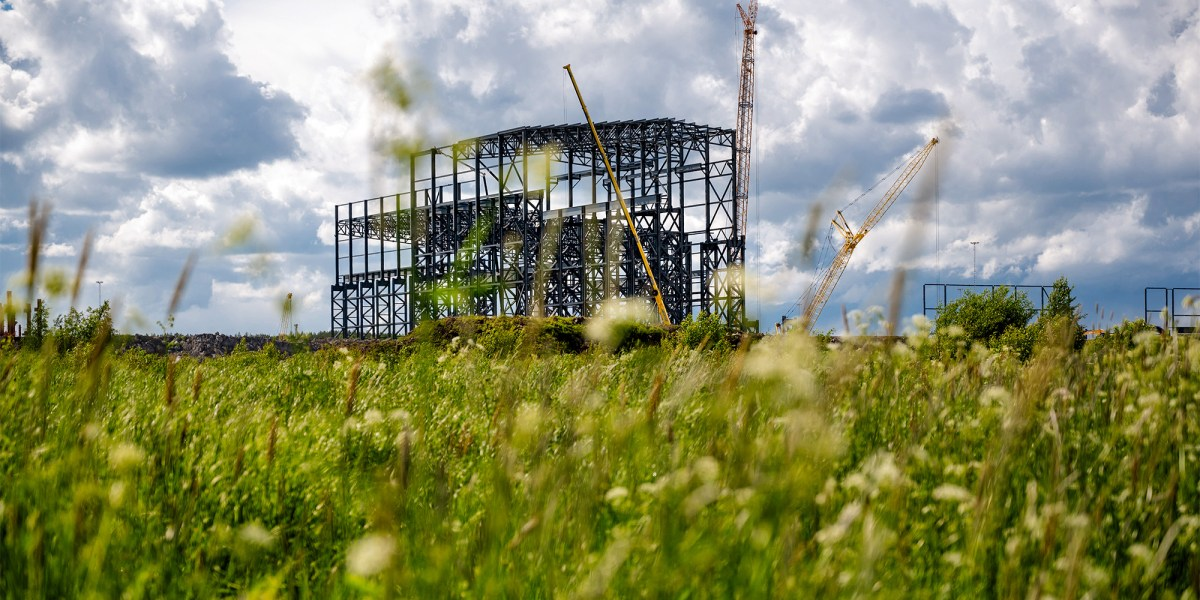
The world’s first industrial-scale plant for green steel promises a cleaner future
As of 2023, nearly 2 billion metric tons of steel were being produced annually, enough to cover Manhattan in a layer more than 13 feet thick.
Making this metal produces a huge amount of carbon dioxide. Overall, steelmaking accounts for around 8% of the world’s carbon emissions—one of the largest industrial emitters and far more than such sources as aviation.
A handful of groups and companies are now making serious progress toward low- or zero-emission steel. Among them, the Swedish company Stegra stands out. The startup is currently building the first industrial-scale plant in the world to make green steel. But can it deliver on its promises? Read the full story.
—Douglas Main
We can still have nice things
A place for comfort, fun and distraction to brighten up your day. (Got any ideas? Drop me a line or skeet ’em at me.)
+ Spoiler haters look away now: these are the best movie endings of all.
+ 27 years on, this bop from the Godzilla soundtrack still sounds like the future.
+ Inside the race to preserve the very first color photographs for generations to come.
+ Origami space planes sound very cool.