Large language models are famous for their ability to make things up—in fact, it’s what they’re best at. But their inability to tell fact from fiction has left many businesses wondering if using them is worth the risk.
A new tool created by Cleanlab, an AI startup spun out of a quantum computing lab at MIT, is designed to give high-stakes users a clearer sense of how trustworthy these models really are. Called the Trustworthy Language Model, it gives any output generated by a large language model a score between 0 and 1, according to its reliability. This lets people choose which responses to trust and which to throw out. In other words: a BS-o-meter for chatbots.
Cleanlab hopes that its tool will make large language models more attractive to businesses worried about how much stuff they invent. “I think people know LLMs will change the world, but they’ve just got hung up on the damn hallucinations,” says Cleanlab CEO Curtis Northcutt.
Chatbots are quickly becoming the dominant way people look up information on a computer. Search engines are being redesigned around the technology. Office software used by billions of people every day to create everything from school assignments to marketing copy to financial reports now comes with chatbots built in. And yet a study put out in November by Vectara, a startup founded by former Google employees, found that chatbots invent information at least 3% of the time. It might not sound like much, but it’s a potential for error most businesses won’t stomach.
Cleanlab’s tool is already being used by a handful of companies, including Berkeley Research Group, a UK-based consultancy specializing in corporate disputes and investigations. Steven Gawthorpe, associate director at Berkeley Research Group, says the Trustworthy Language Model is the first viable solution to the hallucination problem that he has seen: “Cleanlab’s TLM gives us the power of thousands of data scientists.”
In 2021, Cleanlab developed technology that discovered errors in 34 popular data sets used to train machine-learning algorithms; it works by by measuring the differences in output across a range of models trained on that data. That tech is now used by several large companies, including Google, Tesla, and the banking giant Chase. The Trustworthy Language Model takes the same basic idea—that disagreements between models can be used to measure the trustworthiness of the overall system—and applies it to chatbots.
In a demo Cleanlab gave to MIT Technology Review last week, Northcutt typed a simple question into ChatGPT: “How many times does the letter ‘n’ appear in ‘enter’?” ChatGPT answered: “The letter ‘n’ appears once in the word ‘enter.’” That correct answer promotes trust. But ask the question a few more times and ChatGPT answers: “The letter ‘n’ appears twice in the word ‘enter.’”
“Not only does it often get it wrong, but it’s also random, you never know what it’s going to output,” says Northcutt. “Why the hell can’t it just tell you that it outputs different answers all the time?”
Cleanlab’s aim is to make that randomness more explicit. Northcutt asks the Trustworthy Language Model the same question. “The letter ‘n’ appears once in the word ‘enter,’” it says—and scores its answer 0.63. Six out of 10 is not a great score, suggesting that the chatbot’s answer to this question should not be trusted.
It’s a basic example, but it makes the point. Without the score, you might think the chatbot knew what it was talking about, says Northcutt. The problem is that data scientists testing large language models in high-risk situations could be misled by a few correct answers and assume that future answers will be correct too: “They try things out, they try a few examples, and they think this works. And then they do things that result in really bad business decisions.”
The Trustworthy Language Model draws on multiple techniques to calculate its scores. First, each query submitted to the tool is sent to several different large language models. Cleanlab is using five versions of DBRX, an open-source model developed by Databricks, an AI firm based in San Francisco. (But the tech will work with any model, says Northcutt, including Meta’s Llama models or OpenAI’s GPT series, the models behind ChatpGPT.) If the responses from each of these models are the same or similar, it will contribute to a higher score.
At the same time, the Trustworthy Language Model also sends variations of the original query to each of the DBRX models, swapping in words that have the same meaning. Again, if the responses to synonymous queries are similar, it will contribute to a higher score. “We mess with them in different ways to get different outputs and see if they agree,” says Northcutt.
The tool can also get multiple models to bounce responses off one another: “It’s like, ‘Here’s my answer—what do you think?’ ‘Well, here’s mine—what do you think?’ And you let them talk.” These interactions are monitored and measured and fed into the score as well.
Nick McKenna, a computer scientist at Microsoft Research in Cambridge, UK, who works on large language models for code generation, is optimistic that the approach could be useful. But he doubts it will be perfect. “One of the pitfalls we see in model hallucinations is that they can creep in very subtly,” he says.
In a range of tests across different large language models, Cleanlab shows that its trustworthiness scores correlate well with the accuracy of those models’ responses. In other words, scores close to 1 line up with correct responses, and scores close to 0 line up with incorrect ones. In another test, they also found that using the Trustworthy Language Model with GPT-4 produced more reliable responses than using GPT-4 by itself.
Large language models generate text by predicting the most likely next word in a sequence. In future versions of its tool, Cleanlab plans to make its scores even more accurate by drawing on the probabilities that a model used to make those predictions. It also wants to access the numerical values that models assign to each word in their vocabulary, which they use to calculate those probabilities. This level of detail is provided by certain platforms, such as Amazon’s Bedrock, that businesses can use to run large language models.
Cleanlab has tested its approach on data provided by Berkeley Research Group. The firm needed to search for references to health-care compliance problems in tens of thousands of corporate documents. Doing this by hand can take skilled staff weeks. By checking the documents using the Trustworthy Language Model, Berkeley Research Group was able to see which documents the chatbot was least confident about and check only those. It reduced the workload by around 80%, says Northcutt.
In another test, Cleanlab worked with a large bank (Northcutt would not name it but says it is a competitor to Goldman Sachs). Similar to Berkeley Research Group, the bank needed to search for references to insurance claims in around 100,000 documents. Again, the Trustworthy Language Model reduced the number of documents that needed to be hand-checked by more than half.
Running each query multiple times through multiple models takes longer and costs a lot more than the typical back-and-forth with a single chatbot. But Cleanlab is pitching the Trustworthy Language Model as a premium service to automate high-stakes tasks that would have been off limits to large language models in the past. The idea is not for it to replace existing chatbots but to do the work of human experts. If the tool can slash the amount of time that you need to employ skilled economists or lawyers at $2,000 an hour, the costs will be worth it, says Northcutt.
In the long run, Northcutt hopes that by reducing the uncertainty around chatbots’ responses, his tech will unlock the promise of large language models to a wider range of users. “The hallucination thing is not a large-language-model problem,” he says. “It’s an uncertainty problem.”
This is today’s edition of The Download, our weekday newsletter that provides a daily dose of what’s going on in the world of technology.
An AI startup made a hyperrealistic deepfake of me that’s so good it’s scary
Until now, AI-generated videos of people have tended to have some stiffness, glitchiness, or other unnatural elements that make them pretty easy to differentiate from reality.
For the past several years, AI video startup Synthesia has produced these kinds of AI-generated avatars. But today it launches a new generation, its first to take advantage of the latest advancements in generative AI, and they are more realistic and expressive than anything we’ve seen before.
While today’s release means almost anyone will now be able to make a digital double, before the technology went public, Synthesia agreed to make one of Melissa Heikkilä, our senior AI reporter.
This technological progress signals a much larger shift. Increasingly, so much of what we see on our screens is generated (or at least tinkered with) by AI, and it is becoming more and more difficult to distinguish what is real from what is not. And this threatens our trust in everything we see, which could have very dangerous consequences. Read the full story and check out the synthetic version of Melissa.
Want less mining? Switch to clean energy.
Political fights over mining and minerals are heating up, and there are growing concerns about how to source the materials the world needs to build new energy technologies.
But low-emissions energy sources, including wind, solar, and nuclear power, have a smaller mining footprint than coal and natural gas, according to a new report from the Breakthrough Institute released today.
The report’s findings add to a growing body of evidence that technologies used to address climate change will likely lead to a future with less mining than a world powered by fossil fuels. Read the full story.
—Casey Crownhart
In the climate world, hydrogen is perhaps the ultimate multi-tool. It can be used in fuel cells or combustion engines and is sometimes called the Swiss Army knife for cleaning up emissions. But the reality today is that hydrogen is much more of a climate problem than a solution. To find out why, check out the latest edition of The Spark, our weekly climate and energy newsletter. Sign up to receive it in your inbox every Wednesday.
A new kind of gene-edited pig kidney was just transplanted into a person
The news: A month ago, Richard Slayman became the first living person to receive a kidney transplant from a gene-edited pig. Now, a team of researchers from NYU Langone Health reports that Lisa Pisano, a 54-year-old woman from New Jersey, has become the second.
Why it matters: Pisano’s new kidney came from pigs that carry just a single genetic alteration—to eliminate a specific sugar called alpha-gal, which can trigger immediate organ rejection. In the coming weeks, doctors will be monitoring Pisano closely for signs of organ rejection. If it’s successful, researchers hope the approach could make scaling up the production of pig organs simpler. Read the full story.
—Cassandra Willyard
Almost every Chinese keyboard app has a security flaw that reveals what users type
In a nutshell: Almost all keyboard apps used by Chinese people around the world share a security loophole that makes it possible to spy on what users are typing.
Why it’s a big deal: The vulnerability, which allows the keystroke data that these apps send to the cloud to be intercepted, has existed for years and could have been exploited by cybercriminals and state surveillance groups, according to researchers at the Citizen Lab, a technology and security research lab affiliated with the University of Toronto. Read the full story.
—Zeyi Yang
The must-reads
I’ve combed the internet to find you today’s most fun/important/scary/fascinating stories about technology.
1 Meta’s AI push is only just beginning The company plans to sink $40 billion into its AI projects this year alone—but it hasn’t worked out how to make money from them yet. (Insider $) + The news didn’t go down well with Meta’s investors. (The Information $)+ Mark Zuckerberg isn’t ready to give up on the metaverse just yet. (FT $)
2 US chipmaker Micron has been given a major boost To the tune of $13.6 billion in government funding. (FT $) + It could be several months before the money arrives, though. (Bloomberg $)
3 A nuclear fusion experiment has overcome two major barriers But we don’t know if the operative ‘sweet spot’ it identified could be replicated in larger reactors. (New Scientist $) + The next generation of nuclear reactors is getting more advanced. (MIT Technology Review)
4 The US wants Binance’s founder to spend three years in prison However, lawyers for Changpeng Zhao argue he shouldn’t go to prison at all. (CoinDesk) + The cryptocurrency exchange is attempting to distance itself from its former CEO. (NYT $)
5 Nvidia is gobbling up promising-looking startups It’s in the company’s interests to reduce the high costs of running AI models. (The Information $)
6 In Saudi Arabia, AI is the new oil And US tech giants are scrambling to get involved. (NYT $)
7 The Earth is rotating more slowly than it used to You can blame climate change for the gradual slowdown. (Economist $) + Three climate technologies breaking through in 2024. (MIT Technology Review)
8 These men are repatriating colonial artifacts in audacious digital heists Their work raises urgent questions about cultural ownership and appropriation. (The Guardian) + AI is bringing the internet to submerged Roman ruins. (MIT Technology Review)
9 Robocalls are one of life’s nuisances David Frankel has spent an impressive 12 years trying to stop them. (IEEE Spectrum) + Call centers’ days could be numbered, thanks to the rise of AI. (FT $)
10 Seaweed could be a rich resource of precious minerals A new project is hoping to get some answers. (Hakai Magazine)
Quote of the day
“No patient should be a guinea pig, and no nurse should be replaced by a robot.”
—Cathy Kennedy, co-president of the California Nurses Association, criticizes the creep of AI into healthcare without safeguards, 404 Media reports.
The big story
The rise of the tech ethics congregation
August 2023
Just before Christmas last year, a pastor preached a gospel of morals over money to several hundred members of his flock. But the leader in question was not an ordained minister, nor even a religious man.
Polgar, 44, is the founder of All Tech Is Human, a nonprofit organization devoted to promoting ethics and responsibility in tech. His congregation is undergoing dramatic growth in an age when the life of the spirit often struggles to compete with cold, hard, capitalism.
Its leaders believe there are large numbers of individuals in and around the technology world, often from marginalized backgrounds, who wish tech focused less on profits and more on being a force for ethics and justice. But attempts to stay above the fray can cause more problems than they solve. Read the full story.
—Greg M. Epstein
We can still have nice things
A place for comfort, fun and distraction to brighten up your day. (Got any ideas? Drop me a line or tweet ’em at me.)
+ Roger Federer sounds like an all-round nice guy. + This list of the year’s most anticipated tours is making me excited for summer. + If only all cakes were this artistic. + What are you waiting for—now’s the time to make reservations at the world’s hottest new restaurants.
Political fights over mining and minerals are heating up, and there are growing environmental and sociological concerns about how to source the materials the world needs to build new energy technologies.
But low-emissions energy sources, including wind, solar, and nuclear power, have a smaller mining footprint than coal and natural gas, according to a new report from the Breakthrough Institute released today.
The report’s findings add to a growing body of evidence that technologies used to address climate change will likely lead to a future with less mining than a world powered by fossil fuels. However, experts point out that oversight will be necessary to minimize harm from the mining needed to transition to lower-emission energy sources.
“In many ways, we talk so much about the mining of clean energy technologies, and we forget about the dirtiness of our current system,” says Seaver Wang, an author of the report and co-director of Climate and Energy at the Breakthrough Institute, an environmental research center.
In the new analysis, Wang and his colleagues considered the total mining footprint of different energy technologies, including the amount of material needed for these energy sources and the total amount of rock that needs to be moved to extract that material.
Many minerals appear in small concentrations in source rock, so the process of extracting them has a large footprint relative to the amount of final product. A mining operation would need to move about seven kilograms of rock to get one kilogram of aluminum, for instance. For copper, the ratio is much higher, at over 500 to one. Taking these ratios into account allows for a more direct comparison of the total mining required for different energy sources.
With this adjustment, it becomes clear that the energy source with the highest mining burden is coal. Generating one gigawatt-hour of electricity with coal requires 20 times the mining footprint as generating the same electricity with low-carbon power sources like wind and solar. Producing the same electricity with natural gas requires moving about twice as much rock.
Tallying up the amount of rock moved is an imperfect approximation of the potential environmental and sociological impact of mining related to different technologies, Wang says, but the report’s results allow researchers to draw some broad conclusions. One is that we’re on track for less mining in the future.
Other researchers have projected a decrease in mining accompanying a move to low-emissions energy sources. “We mine so many fossil fuels today that the sum of mining activities decreases even when we assume an incredibly rapid expansion of clean energy technologies,” Joey Nijnens, a consultant at Monitor Deloitte and author of another recent study on mining demand, said in an email.
That being said, potentially moving less rock around in the future “hardly means that society shouldn’t look for further opportunities to reduce mining impacts throughout the energy transition,” Wang says.
There’s already been progress in cutting down on the material required for technologies like wind and solar. Solar modules have gotten more efficient, so the same amount of material can yield more electricity generation. Recycling can help further cut material demand in the future, and it will be especially crucial to reduce the mining needed to build batteries.
Resource extraction may decrease overall, but it’s also likely to increase in some places as our demands change, researchers pointed out in a 2021 study. Between 32% and 40% of the mining increase in the future could occur in countries with weak, poor, or failing resource governance, where mining is more likely to harm the environment and may fail to benefit people living near the mining projects.
“We need to ensure that the energy transition is accompanied by responsible mining that benefits local communities,” Takuma Watari, a researcher at the National Institute for Environmental Studies and an author of the study, said via email. Otherwise, the shift to lower-emissions energy sources could lead to a reduction of carbon emissions in the Global North “at the expense of increasing socio-environmental risks in local mining areas, often in the Global South.”
Strong oversight and accountability are crucial to make sure that we can source minerals in a responsible way, Wang says: “We want a rapid energy transition, but we also want an energy transition that’s equitable.”
This article is from The Spark, MIT Technology Review’s weekly climate newsletter. To receive it in your inbox every Wednesday, sign up here.
From toaster ovens that work as air fryers to hair dryers that can also curl your hair, single tools that do multiple jobs have an undeniable appeal.
In the climate world, hydrogen is perhaps the ultimate multi-tool. It can be used in fuel cells or combustion engines and is sometimes called the Swiss Army knife for cleaning up emissions. I’ve written about efforts to use hydrogen in steelmaking, cars, and aviation, just to name a few. And a new story for our latest print issue explores the potential of hydrogen trains.
Hydrogen might be a million tools in one, but some experts argue that it can’t do it all, and some uses could actually be distractions from real progress on emissions. So let’s dig into where we might see hydrogen used and where it might make the biggest emissions cuts.
Hydrogen could play a role in cleaning up nearly every sector of the economy—in theory. The reality today is that hydrogen is much more of a climate problem than a solution.
Most hydrogen is used in oil refining, chemical production, and heavy industry, and it is almost exclusively generated using fossil fuels. In total, hydrogen production and use accounted for around 900 million metric tons of carbon dioxide emissions in 2022.
There are technologies on the table to clean up hydrogen production. But global hydrogen demand hit 95 million metric tons in 2022, and only about 0.7% of that was met with low-emissions hydrogen. (For more on various hydrogen sources and why the details matter, check out this newsletter from last year.)
Transforming the global hydrogen economy won’t be fast or cheap, but it is happening. Annual production of low-emissions hydrogen is on track to hit 38 million metric tons by 2030, according to the International Energy Agency. The pipeline of new projects is growing quickly, but so is hydrogen demand, which could hit 150 million metric tons by the end of the decade.
Basically every time I report on hydrogen, whether in transportation or energy or industry, experts tell me it’s crucial to be smart about where that low-emissions hydrogen is going. There are, of course, disagreements about what exactly the order of priorities should be, but I’ve seen a few patterns.
First, the focus should probably be on cleaning up production of the hydrogen we’re already using for things like fertilizer. “The main thing is replacing existing uses,” as Geert de Cock, electricity and energy manager at the European Federation for Transport and Environment, put it when I spoke with him earlier this year for a story about hydrogen cars.
Beyond that, though, hydrogen will probably be most useful in industries where there aren’t other practical options already on the table.
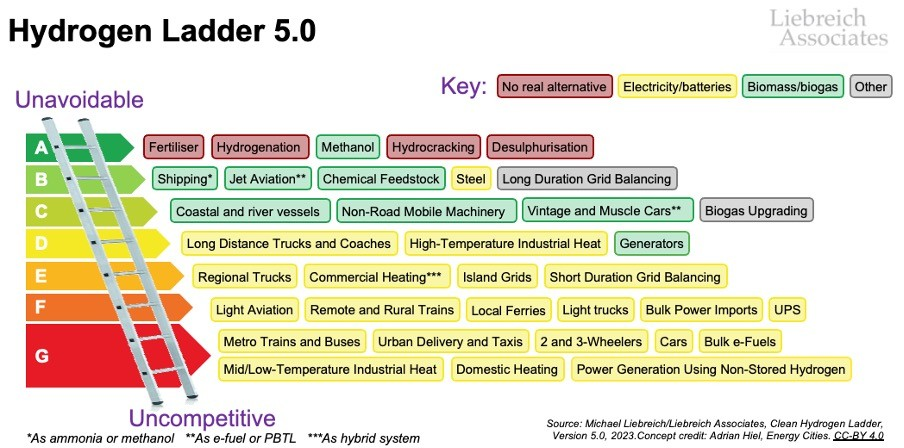
That’s a central idea behind an infographic I think about a lot: the Hydrogen Ladder, conceptualized and updated frequently by Michael Liebreich, founder of BloombergNEF. In this graphic, he basically ranks just about every use of hydrogen, from “unavoidable” uses at the top to “uncompetitive” ones at the bottom. His metrics include cost, convenience, and economics.
At the top of this ladder are existing uses and industries where there’s no alternative to hydrogen. There, Liebrich agrees with most experts I’ve spoken with about hydrogen.
On the next few rungs come sectors where there’s still no dominant technical solution for cleaning up emissions, like shipping, aviation, and steel production. You might recognize these as famously “hard to solve” sectors.
Heavy industry often requires high temperatures, which have historically been expensive to achieve with electricity. Cost and technical challenges have pushed companies to explore using hydrogen in processes like steelmaking. For shipping and aviation, there are strict limitations on the mass and size of the fueling system, and batteries can’t make the cut just yet, leaving hydrogen a potential opening.
Toward the bottom of Liebreich’s ladder are applications where we already have clear decarbonization options available today, making hydrogen a long shot. Take domestic heating, for example. Heat pumps are breaking through in a massive way (we put them on our list of 10 Breakthrough Technologies this year), so hydrogen has some stiff competition there.
Cars also rank right at the bottom of the ladder, alongside two- and three-wheeled vehicles, since battery-powered transit is becoming increasingly popular and charging infrastructure is growing. That leaves little room for hydrogen vehicles to make a dent, at least in the near future.
I’m not counting hydrogen out as a fuel for any one use, and there’s plenty of room to disagree on particular uses and their particular rungs. But given that we have a growing number of options in our arsenal to fight climate change, I’m betting that as a general rule, hydrogen will find its niches rather than emerge as the magic multi-tool that saves us all.
Now read the rest of The Spark
Related reading
A fight over hydrogen trains reveals that cleaning up transportation is a political problem as much as it is a technical one. Read more in this story from Benjamin Schneider, featured in our latest magazine issue.
It’s here! The Build issue of our print magazine just dropped, and it’s a good one.
Dive into this story about how artificial snowdrifts could help protect seal pups from climate change. Volunteers in Finland brave freezing temperatures to help create an environment for endangered seals to thrive.
Or if you’re feeling hungry, I’d recommend this look at how Climax Foods is using machine learning to create vegan cheeses that can stand up to discerning palates. (I have tasted these and can attest that some of them are truly uncanny.)
A solar giant is moving manufacturing to the US. Tariffs and tax incentives are reshaping the solar market, but things could get challenging fast, as my colleague Zeyi Yang reported this week. (MIT Technology Review)
In a new op-ed, Daniele Visioni makes the case that proposals to crack down on geoengineering are misguided. He calls for more research, including outdoor experiments, to make better decisions about climate interventions. (MIT Technology Review)
Americans have some surprising feelings about EVs. And in a recent survey, fewer than half of US adults said they think EVs are better for the climate than gas-powered ones. (Sustainability by numbers)
An Australian supplier of fast charging equipment for EVs is in financial trouble. Tritium told regulators that it’s insolvent, and it’s unclear whether the company will be able to fill orders or service existing chargers. (Canary Media)
Offshore wind has faced its fair share of challenges, but the death of a mega-turbine may have played a major role. GE Vernova canceled plans for a 18-megawatt machine, causing ripples that ended in New York’s move to cancel contracts for three massive projects last week. (E&E News)
The UK’s final coal power station is set to close within the year. Here’s a look at the last site generating what used to be the country’s main source of energy. (The Guardian)
Is it time to retire the term “clean energy”? The term is a convenient way to roll up energy sources that cut emissions, like renewables and nuclear power, but some argue that it glosses over environmental harms. (Inside Climate News)
California saw batteries become the single largest source of power on the grid one evening last week—a major moment for energy storage. (Heatmap News)
I’m stressed and running late, because what do you wear for the rest of eternity?
This makes it sound like I’m dying, but it’s the opposite. I am, in a way, about to live forever, thanks to the AI video startup Synthesia. For the past several years, the company has produced AI-generated avatars, but today it launches a new generation, its first to take advantage of the latest advancements in generative AI, and they are more realistic and expressive than anything I’ve ever seen. While today’s release means almost anyone will now be able to make a digital double, on this early April afternoon, before the technology goes public, they’ve agreed to make one of me.
When I finally arrive at the company’s stylish studio in East London, I am greeted by Tosin Oshinyemi, the company’s production lead. He is going to guide and direct me through the data collection process—and by “data collection,” I mean the capture of my facial features, mannerisms, and more—much like he normally does for actors and Synthesia’s customers.
In this AI-generated footage, synthetic “Melissa” gives a performance of Hamlet’s famous soliloquy. (The magazine had no role in producing this video.)
SYNTHESIA
He introduces me to a waiting stylist and a makeup artist, and I curse myself for wasting so much time getting ready. Their job is to ensure that people have the kind of clothes that look good on camera and that they look consistent from one shot to the next. The stylist tells me my outfit is fine (phew), and the makeup artist touches up my face and tidies my baby hairs. The dressing room is decorated with hundreds of smiling Polaroids of people who have been digitally cloned before me.
Apart from the small supercomputer whirring in the corridor, which processes the data generated at the studio, this feels more like going into a news studio than entering a deepfake factory.
I joke that Oshinyemi has what MIT Technology Review might call a job title of the future: “deepfake creation director.”
“We like the term ‘synthetic media’ as opposed to ‘deepfake,’” he says.
It’s a subtle but, some would argue, notable difference in semantics. Both mean AI-generated videos or audio recordings of people doing or saying something that didn’t necessarily happen in real life. But deepfakes have a bad reputation. Since their inception nearly a decade ago, the term has come to signal something unethical, says Alexandru Voica, Synthesia’s head of corporate affairs and policy. Think of sexual content produced without consent, or political campaigns that spread disinformation or propaganda.
“Synthetic media is the more benign, productive version of that,” he argues. And Synthesia wants to offer the best version of that version.
Until now, all AI-generated videos of people have tended to have some stiffness, glitchiness, or other unnatural elements that make them pretty easy to differentiate from reality. Because they’re so close to the real thing but not quiteit, these videos can make people feel annoyed or uneasy or icky—a phenomenon commonly known as the uncanny valley. Synthesia claims its new technology will finally lead us out of the valley.
Thanks to rapid advancements in generative AI and a glut of training data created by human actors that has been fed into its AI model, Synthesia has been able to produce avatars that are indeed more humanlike and more expressive than their predecessors. The digital clones are better able to match their reactions and intonation to the sentiment of their scripts—acting more upbeat when talking about happy things, for instance, and more serious or sad when talking about unpleasant things. They also do a better job matching facial expressions—the tiny movements that can speak for us without words.
But this technological progress also signals a much larger social and cultural shift. Increasingly, so much of what we see on our screens is generated (or at least tinkered with) by AI, and it is becoming more and more difficult to distinguish what is real from what is not. This threatens our trust in everything we see, which could have very real, very dangerous consequences.
“I think we might just have to say goodbye to finding out about the truth in a quick way,” says Sandra Wachter, a professor at the Oxford Internet Institute, who researches the legal and ethical implications of AI. “The idea that you can just quickly Google something and know what’s fact and what’s fiction—I don’t think it works like that anymore.”
Tosin Oshinyemi, the company’s production lead, guides and directs actors and customers through the data collection process.
DAVID VINTINER
So while I was excited for Synthesia to make my digital double, I also wondered if the distinction between synthetic media and deepfakes is fundamentally meaningless. Even if the former centers a creator’s intent and, critically, a subject’s consent, is there really a way to make AI avatars safely if the end result is the same? And do we really want to get out of the uncanny valley if it means we can no longer grasp the truth?
But more urgently, it was time to find out what it’s like to see a post-truth version of yourself.
Almost the real thing
A month before my trip to the studio, I visited Synthesia CEO Victor Riparbelli at his office near Oxford Circus. As Riparbelli tells it, Synthesia’s origin story stems from his experiences exploring avant-garde, geeky techno music while growing up in Denmark. The internet allowed him to download software and produce his own songs without buying expensive synthesizers.
“I’m a huge believer in giving people the ability to express themselves in the way that they can, because I think that that provides for a more meritocratic world,” he tells me.
He saw the possibility of doing something similar with video when he came across research on using deep learning to transfer expressions from one human face to another on screen.
“What that showcased was the first time a deep-learning network could produce video frames that looked and felt real,” he says.
That research was conducted by Matthias Niessner, a professor at the Technical University of Munich, who cofounded Synthesia with Riparbelli in 2017, alongside University College London professor Lourdes Agapito and Steffen Tjerrild, whom Riparbelli had previously worked with on a cryptocurrency project.
Initially the company built lip-synching and dubbing tools for the entertainment industry, but it found that the bar for this technology’s quality was very high and there wasn’t much demand for it. Synthesia changed direction in 2020 and launched its first generation of AI avatars for corporate clients. That pivot paid off. In 2023, Synthesia achieved unicorn status, meaning it was valued at over $1 billion—making it one of the relatively few European AI companies to do so.
That first generation of avatars looked clunky, with looped movements and little variation. Subsequent iterations started looking more human, but they still struggled to say complicated words, and things were slightly out of sync.
The challenge is that people are used to looking at other people’s faces. “We as humans know what real humans do,” says Jonathan Starck, Synthesia’s CTO. Since infancy, “you’re really tuned in to people and faces. You know what’s right, so anything that’s not quite right really jumps out a mile.”
These earlier AI-generated videos, like deepfakes more broadly, were made using generative adversarial networks, or GANs—an older technique for generating images and videos that uses two neural networks that play off one another. It was a laborious and complicated process, and the technology was unstable.
But in the generative AI boom of the last year or so, the company has found it can create much better avatars using generative neural networks that produce higher quality more consistently. The more data these models are fed, the better they learn. Synthesia uses both large language models and diffusion models to do this; the former help the avatars react to the script, and the latter generate the pixels.
Despite the leap in quality, the company is still not pitching itself to the entertainment industry. Synthesia continues to see itself as a platform for businesses. Its bet is this: As people spend more time watching videos on YouTube and TikTok, there will be more demand for video content. Young people are already skipping traditional search and defaulting to TikTok for information presented in video form. Riparbelli argues that Synthesia’s tech could help companies convert their boring corporate comms and reports and training materials into content people will actually watch and engage with. He also suggests it could be used to make marketing materials.
He claims Synthesia’s technology is used by 56% of the Fortune 100, with the vast majority of those companies using it for internal communication. The company lists Zoom, Xerox, Microsoft, and Reuters as clients. Services start at $22 a month.
This, the company hopes, will be a cheaper and more efficient alternative to video from a professional production company—and one that may be nearly indistinguishable from it. Riparbelli tells me its newest avatars could easily fool a person into thinking they are real.
“I think we’re 98% there,” he says.
For better or worse, I am about to see it for myself.
Don’t be garbage
In AI research, there is a saying: Garbage in, garbage out. If the data that went into training an AI model is trash, that will be reflected in the outputs of the model. The more data points the AI model has captured of my facial movements, microexpressions, head tilts, blinks, shrugs, and hand waves, the more realistic the avatar will be.
Back in the studio, I’m trying really hard not to be garbage.
I am standing in front of a green screen, and Oshinyemi guides me through the initial calibration process, where I have to move my head and then eyes in a circular motion. Apparently, this will allow the system to understand my natural colors and facial features. I am then asked to say the sentence “All the boys ate a fish,” which will capture all the mouth movements needed to form vowels and consonants. We also film footage of me “idling” in silence.
The more data points the AI system has on facial movements, microexpressions, head tilts, blinks, shrugs, and hand waves, the more realistic the avatar will be.
DAVID VINTINER
He then asks me to read a script for a fictitious YouTuber in different tones, directing me on the spectrum of emotions I should convey. First I’m supposed to read it in a neutral, informative way, then in an encouraging way, an annoyed and complain-y way, and finally an excited, convincing way.
“Hey, everyone—welcome back to Elevate Her with your host, Jess Mars. It’s great to have you here. We’re about to take on a topic that’s pretty delicate and honestly hits close to home—dealing with criticism in our spiritual journey,” I read off the teleprompter, simultaneously trying to visualize ranting about something to my partner during the complain-y version. “No matter where you look, it feels like there’s always a critical voice ready to chime in, doesn’t it?”
Don’t be garbage, don’t be garbage, don’t be garbage.
“That was really good. I was watching it and I was like, ‘Well, this is true. She’s definitely complaining,’” Oshinyemi says, encouragingly. Next time, maybe add some judgment, he suggests.
We film several takes featuring different variations of the script. In some versions I’m allowed to move my hands around. In others, Oshinyemi asks me to hold a metal pin between my fingers as I do. This is to test the “edges” of the technology’s capabilities when it comes to communicating with hands, Oshinyemi says.
Historically, making AI avatars look natural and matching mouth movements to speech has been a very difficult challenge, says David Barber, a professor of machine learning at University College London who is not involved in Synthesia’s work. That is because the problem goes far beyond mouth movements; you have to think about eyebrows, all the muscles in the face, shoulder shrugs, and the numerous different small movements that humans use to express themselves.
The motion capture process uses reference patterns to help align footage captured from multiple angles around the subject.
DAVID VINTINER
Synthesia has worked with actors to train its models since 2020, and their doubles make up the 225 stock avatars that are available for customers to animate with their own scripts. But to train its latest generation of avatars, Synthesia needed more data; it has spent the past year working with around 1,000 professional actors in London and New York. (Synthesia says it does not sell the data it collects, although it does release some of it for academic research purposes.)
The actors previously got paid each time their avatar was used, but now the company pays them an up-front fee to train the AI model. Synthesia uses their avatars for three years, at which point actors are asked if they want to renew their contracts. If so, they come into the studio to make a new avatar. If not, the company will delete their data. Synthesia’s enterprise customers can also generate their own custom avatars by sending someone into the studio to do much of what I’m doing.
The initial calibration process allows the system to understand the subject’s natural colors and facial features.
Synthesia also collects voice samples. In the studio, I read a passage indicating that I explicitly consent to having my voice cloned.
Between takes, the makeup artist comes in and does some touch-ups to make sure I look the same in every shot. I can feel myself blushing because of the lights in the studio, but also because of the acting. After the team has collected all the shots it needs to capture my facial expressions, I go downstairs to read more text aloud for voice samples.
This process requires me to read a passage indicating that I explicitly consent to having my voice cloned, and that it can be used on Voica’s account on the Synthesia platform to generate videos and speech.
Consent is key
This process is very different from the way many AI avatars, deepfakes, or synthetic media—whatever you want to call them—are created.
Most deepfakes aren’t created in a studio. Studies have shown that the vast majority of deepfakes online are nonconsensual sexual content, usually using images stolen from social media. Generative AI has made the creation of these deepfakes easy and cheap, and there have been several high-profile cases in the US and Europe of children and women being abused in this way. Experts have also raised alarms that the technology can be used to spread political disinformation, a particularly acute threat given the record number of elections happening around the world this year.
Synthesia’s policy is to not create avatars of people without their explicit consent. But it hasn’t been immune from abuse. Last year, researchers found pro-China misinformation that was created using Synthesia’s avatars and packaged as news, which the company said violated its terms of service.
Since then, the company has put more rigorous verification and content moderation systems in place. It applies a watermark with information on where and how the AI avatar videos were created. Where it once had four in-house content moderators, people doing this work now make up 10% of its 300-person staff. It also hired an engineer to build better AI-powered content moderation systems. These filters help Synthesia vet every single thing its customers try to generate. Anything suspicious or ambiguous, such as content about cryptocurrencies or sexual health, gets forwarded to the human content moderators. Synthesia also keeps a record of all the videos its system creates.
And while anyone can join the platform, many features aren’t available until people go through an extensive vetting system similar to that used by the banking industry, which includes talking to the sales team, signing legal contracts, and submitting to security auditing, says Voica. Entry-level customers are limited to producing strictly factual content, and only enterprise customers using custom avatars can generate content that contains opinions. On top of this, only accredited news organizations are allowed to create content on current affairs.
“We can’t claim to be perfect. If people report things to us, we take quick action, [such as] banning or limiting individuals or organizations,” Voica says. But he believes these measures work as a deterrent, which means most bad actors will turn to freely available open-source tools instead.
I put some of these limits to the test when I head to Synthesia’s office for the next step in my avatar generation process. In order to create the videos that will feature my avatar, I have to write a script. Using Voica’s account, I decide to use passages from Hamlet, as well as previous articles I have written. I also use a new feature on the Synthesia platform, which is an AI assistant that transforms any web link or document into a ready-made script. I try to get my avatar to read news about the European Union’s new sanctions against Iran.
Voica immediately texts me: “You got me in trouble!”
The system has flagged his account for trying to generate content that is restricted.
AI-powered content filters help Synthesia vet every single thing its customers try to generate. Only accredited news organizations are allowed to create content on current affairs.
COURTESY OF SYNTHESIA
Offering services without these restrictions would be “a great growth strategy,” Riparbelli grumbles. But “ultimately, we have very strict rules on what you can create and what you cannot create. We think the right way to roll out these technologies in society is to be a little bit over-restrictive at the beginning.”
Still, even if these guardrails operated perfectly, the ultimate result would nevertheless be an internet where everything is fake. And my experiment makes me wonder how we could possibly prepare ourselves.
Our information landscape already feels very murky. On the one hand, there is heightened public awareness that AI-generated content is flourishing and could be a powerful tool for misinformation. But on the other, it is still unclear whether deepfakes are used for misinformation at scale and whether they’re broadly moving the needle to change people’s beliefs and behaviors.
If people become too skeptical about the content they see, they might stop believing in anything at all, which could enable bad actors to take advantage of this trust vacuum and lie about the authenticity of real content. Researchers have called this the “liar’s dividend.” They warn that politicians, for example, could claim that genuinely incriminating information was fake or created using AI.
Claire Leibowicz, the head of the AI and media integrity at the nonprofit Partnership on AI, says she worries that growing awareness of this gap will make it easier to “plausibly deny and cast doubt on real material or media as evidence in many different contexts, not only in the news, [but] also in the courts, in the financial services industry, and in many of our institutions.” She tells me she’s heartened by the resources Synthesia has devoted to content moderation and consent but says that process is never flawless.
Even Riparbelli admits that in the short term, the proliferation of AI-generated content will probably cause trouble. While people have been trained not to believe everything they read, they still tend to trust images and videos, he adds. He says people now need to test AI products for themselves to see what is possible, and should not trust anything they see online unless they have verified it.
Never mind that AI regulation is still patchy, and the tech sector’s efforts to verify content provenance are still in their early stages. Can consumers, with their varying degrees of media literacy, really fight the growing wave of harmful AI-generated content through individual action?
Watch out, PowerPoint
The day after my final visit, Voica emails me the videos with my avatar. When the first one starts playing, I am taken aback. It’s as painful as seeing yourself on camera or hearing a recording of your voice. Then I catch myself. At first I thought the avatar was me.
The more I watch videos of “myself,” the more I spiral. Do I really squint that much? Blink that much? And move my jaw like that? Jesus.
It’s good. It’s really good. But it’s not perfect. “Weirdly good animation,” my partner texts me.
“But the voice sometimes sounds exactly like you, and at other times like a generic American and with a weird tone,” he adds. “Weird AF.”
He’s right. The voice is sometimes me, but in real life I umm and ahh more. What’s remarkable is that it picked up on an irregularity in the way I talk. My accent is a transatlantic mess, confused by years spent living in the UK, watching American TV, and attending international school. My avatar sometimes says the word “robot” in a British accent and other times in an American accent. It’s something that probably nobody else would notice. But the AI did.
My avatar’s range of emotions is also limited. It delivers Shakespeare’s “To be or not to be” speech very matter-of-factly. I had guided it to be furious when reading a story I wrote about Taylor Swift’s nonconsensual nude deepfakes; the avatar is complain-y and judgy, for sure, but not angry.
This isn’t the first time I’ve made myself a test subject for new AI. Not too long ago, I tried generating AI avatar images of myself, only to get a bunch of nudes. That experience was a jarring example of just how biased AI systems can be. But this experience—and this particular way of being immortalized—was definitely on a different level.
Carl Öhman, an assistant professor at Uppsala University who has studied digital remains and is the author of a new book, The Afterlife of Data, calls avatars like the ones I made “digital corpses.”
“It looks exactly like you, but no one’s home,” he says. “It would be the equivalent of cloning you, but your clone is dead. And then you’re animating the corpse, so that it moves and talks, with electrical impulses.”
That’s kind of how it feels. The little, nuanced ways I don’t recognize myself are enough to put me off. Then again, the avatar could quite possibly fool anyone who doesn’t know me very well. It really shines when presenting a story I wrote about how the field of robotics could be getting its own ChatGPT moment; the virtual AI assistant summarizes the long read into a decent short video, which my avatar narrates. It is not Shakespeare, but it’s better than many of the corporate presentations I’ve had to sit through. I think if I were using this to deliver an end-of-year report to my colleagues, maybe that level of authenticity would be enough.
And that is the sell, according to Riparbelli: “What we’re doing is more like PowerPoint than it is like Hollywood.”
Once a likeness has been generated, Synthesia is able to generate video presentations quickly from a script. In this video, synthetic “Melissa” summarizes an article real Melissa wrote about Taylor Swift deepfakes.
SYNTHESIA
The newest generation of avatars certainly aren’t ready for the silver screen. They’re still stuck in portrait mode, only showing the avatar front-facing and from the waist up. But in the not-too-distant future, Riparbelli says, the company hopes to create avatars that can communicate with their hands and have conversations with one another. It is also planning for full-body avatars that can walk and move around in a space that a person has generated. (The rig to enable this technology already exists; in fact it’s where I am in the image at the top of this piece.)
But do we really want that? It feels like a bleak future where humans are consuming AI-generated content presented to them by AI-generated avatars and using AI to repackage that into more content, which will likely be scraped to generate more AI. If nothing else, this experiment made clear to me that the technology sector urgently needs to step up its content moderation practices and ensure that content provenance techniques such as watermarking are robust.
Even if Synthesia’s technology and content moderation aren’t yet perfect, they’re significantly better than anything I have seen in the field before, and this is after only a year or so of the current boom in generative AI. AI development moves at breakneck speed, and it is both exciting and daunting to consider what AI avatars will look like in just a few years. Maybe in the future we will have to adopt safewords to indicate that you are in fact communicating with a real human, not an AI.
But that day is not today.
I found it weirdly comforting that in one of the videos, my avatar rants about nonconsensual deepfakes and says, in a sociopathically happy voice, “The tech giants? Oh! They’re making a killing!”