
An SEC approval for spot ETH ETFs looks unlikely but even if the SEC approves exchange traded funds for Ether, investors should learn about total return ETH investment products. That way, they can gain from staking rewards as well as the underlying asset, says Jason Hall, the CEO of Methodic Capital Management.
Read more Haun Ventures has made 48 investments, including some of its token positions, across its early-stage $500 million and $1 billion later-stage acceleration funds.
© 2024 TechCrunch. All rights reserved. For personal use only.
At the 2024 IAB NewFronts event on Wednesday, Snapchat announced a series of new augmented reality (AR) and machine learning (ML) tools designed to help brands and advertisers reach users on the social network with interactive experiences. The company said that it’s been investing in ML and automation to make it faster and easier for […]
© 2024 TechCrunch. All rights reserved. For personal use only.
When Keith Rabois announced he was leaving Founders Fund to return to Khosla Ventures in January, it came as a shock to many in the venture capital ecosystem — and not just because Rabois is a big name in the industry. It was surprising because unlike in many other fields, venture capitalists don’t traditionally move […]
© 2024 TechCrunch. All rights reserved. For personal use only.
Anthropic, the generative AI startup backed by Amazon and Google, is launching a new paid plan aimed at business customers.
© 2024 TechCrunch. All rights reserved. For personal use only.
Mars exploration has always been the exclusive purview of national space agencies, but NASA is trying to change that, awarding a dozen research tasks to private companies as a prelude to commercial support for future missions to the Red Planet. It’s the second time in a month that the agency has shown its desire for […]
© 2024 TechCrunch. All rights reserved. For personal use only.
Eliminating carbon pollution from aviation is one of the most challenging parts of the climate puzzle, simply because large commercial airlines are too heavy and need too much power during takeoff for today’s batteries to do the job.
But one way that companies and governments are striving to make some progress is through the use of various types of sustainable aviation fuels (SAFs), which are derived from non-petroleum sources and promise to be less polluting than standard jet fuel.
This week, the US announced a push to help its biggest commercial crop, corn, become a major feedstock for SAFs.
Federal guidelines announced on April 30 provide a pathway for ethanol producers to earn SAF tax credits within the Inflation Reduction Act, President Biden’s signature climate law, when the fuel is produced from corn or soy grown on farms that adopt certain sustainable agricultural practices.
It’s a limited pilot program, since the subsidy itself expires at the end of this year. But it could set the template for programs in the future that may help ethanol producers generate more and more SAFs, as the nation strives to produce billions of gallons of those fuels per year by 2030.
Consequently, the so-called Climate Smart Agricultural program has already sounded alarm bells among some observers, who fear that the federal government is both overestimating the emissions benefits of ethanol and assigning too much credit to the agricultural practices in question. Those include cover crops, no-till techniques that minimize soil disturbances, and use of “enhanced-efficiency fertilizers,” which are designed to increase uptake by plants and thus reduce runoff into the environment.
The IRA offers a tax credit of $1.25 per gallon for SAFs that are 50% lower in emissions than standard jet fuel, and as much as 50 cents per gallon more for sustainable fuels that are cleaner still. The new program can help corn- or soy-based ethanol meet that threshold when the source crops are produced using some or all of those agricultural practices.
Since the vast majority of US ethanol is produced from corn, let’s focus on the issues around that crop. To get technical, the program allows ethanol producers to subtract 10 grams of carbon dioxide per megajoule of energy, a measure of carbon intensity, from the life-cycle emissions of the fuel when it’s generated from corn produced with all three of the practices mentioned. That’s about an eighth to a tenth of the carbon intensity of gasoline.
Ethanol’s questionable climate footprint
Today, US-generated ethanol is mainly mixed with gasoline. But ethanol producers are eager to develop new markets for the product as electric vehicles make up a larger share of the cars and trucks on the road. Not surprisingly, then, industry trade groups applauded the announcement this week.
The first concern with the new program, however, is that the emissions benefits of corn-based ethanol have been hotly debated for decades.
Corn, like any plant that uses photosynthesis to produce food, sucks up carbon dioxide from the air. But using corn for fuel rather than food also creates pressure to clear more land for farming, a process that releases carbon dioxide from plants and soil. In addition, planting, fertilizing, and harvesting corn produce climate pollution as well, and the same is true of refining, distributing, and burning ethanol.
For its analyses under the new program, the Treasury Department intends to use an updated version of the so-called GREET model to evaluate the life-cycle emissions of SAFs, which was developed by the Department of Energy’s Argonne National Lab. A 2021 study from the lab, relying on that model, concluded that US corn ethanol produced as much as 52% less greenhouse gas than gasoline.
But some researchers and nonprofits have criticized the tool for accepting low estimates of the emissions impacts of land-use changes, among other issues. Other assessments of ethanol emissions have been far more damning.
A 2022 EPA analysis surveyed the findings from a variety of models that estimate the life-cycle emissions of corn-based ethanol and found that in seven out of 20 cases, they exceeded 80% of the climate pollution from gasoline and diesel.
Moreover, the three most recent estimates from those models found ethanol emissions surpassed even the higher-end estimates for gasoline or diesel, Alison Cullen, chair of the EPA’s science advisory board, noted in a 2023 letter to the administrator of the agency.
“Thus, corn starch ethanol may not meet the definition of a renewable fuel” under the federal law that mandates the use of biofuels in the market, she wrote. If so, it’s then well short of the 50% threshold required by the IRA, and some say it’s not clear that the farming practices laid out this week could close the gap.
Agricultural practices
Nikita Pavlenko, who leads the fuels team at the International Council on Clean Transportation, a nonprofit research group, asserted in an email that the climate-smart agricultural provisions “are extremely sloppy” and “are not substantiated.”
He said the Department of Energy and Department of Agriculture especially “put their thumbs on the scale” on the question of land-use changes, using estimates of soy and corn emissions that were 33% to 55% lower than those produced for a program associated with the UN’s International Civil Aviation Organization.
He finds that ethanol sourced from farms using these agriculture practices will still come up short of the IRA’s 50% threshold, and that producers may have to take additional steps to curtail emissions, potentially including adding carbon capture and storage to ethanol facilities or running operations on renewables like wind or solar.
Freya Chay, a program lead at CarbonPlan, which evaluates the scientific integrity of carbon removal methods and other climate actions, says that these sorts of agricultural practices can provide important benefits, including improving soil health, reducing erosion, and lowering the cost of farming. But she and others have stressed that confidently determining when certain practices actually and durably increase carbon in soil is “exceedingly complex” and varies widely depending on soil type, local climate conditions, past practices, and other variables.
One recent study of no-till practices found that the carbon benefits quickly fade away over time and reach nearly zero in 14 years. If so, this technique would do little to help counter carbon emissions from fuel combustion, which can persist in the atmosphere for centuries or more.
“US policy has a long history of asking how to continue justifying investment in ethanol rather than taking a clear-eyed approach to evaluating whether or not ethanol helps us reach our climate goals,” Chay wrote in an email. “In this case, I think scrutiny is warranted around the choice to lean on agricultural practices with uncertain and variable benefits in a way that could unlock the next tranche of public funding for corn ethanol.”
There are many other paths for producing SAFs that are or could be less polluting than ethanol. For example, they can be made from animal fats, agriculture waste, forest trimmings, or non-food plants that grow on land unsuitable for commercial crops. Other companies are developing various types of synthetic fuels, including electrofuels produced by capturing carbon from plants or the air and then combining it with cleanly sourced hydrogen.
But all these methods are much more expensive than extracting and refining fossil fuels, and most of the alternative fuels will still produce more emissions when they’re used than the amount that was pulled out of the atmosphere by the plants or processes in the first place.
The best way to think of these fuels is arguably as a stopgap, a possible way to make some climate progress while smart people strive to develop and build fully emissions-free ways of quickly, safely, and reliably moving things and people around the globe.
A number of moments from my brief sit-down with Sam Altman brought the OpenAI CEO’s worldview into clearer focus. The first was when he pointed to my iPhone SE (the one with the home button that’s mostly hated) and said, “That’s the best iPhone.” More revealing, though, was the vision he sketched for how AI tools will become even more enmeshed in our daily lives than the smartphone.
“What you really want,” he told MIT Technology Review, “is just this thing that is off helping you.” Altman, who was visiting Cambridge for a series of events hosted by Harvard and the venture capital firm Xfund, described the killer app for AI as a “super-competent colleague that knows absolutely everything about my whole life, every email, every conversation I’ve ever had, but doesn’t feel like an extension.” It could tackle some tasks instantly, he said, and for more complex ones it could go off and make an attempt, but come back with questions for you if it needs to.
It’s a leap from OpenAI’s current offerings. Its leading applications, like DALL-E, Sora, and ChatGPT (which Altman referred to as “incredibly dumb” compared with what’s coming next), have wowed us with their ability to generate convincing text and surreal videos and images. But they mostly remain tools we use for isolated tasks, and they have limited capacity to learn about us from our conversations with them.
In the new paradigm, as Altman sees it, the AI will be capable of helping us outside the chat interface and taking real-world tasks off our plates.
Altman on AI hardware’s future
I asked Altman if we’ll need a new piece of hardware to get to this future. Though smartphones are extraordinarily capable, and their designers are already incorporating more AI-driven features, some entrepreneurs are betting that the AI of the future will require a device that’s more purpose built. Some of these devices are already beginning to appear in his orbit. There is the (widely panned) wearable AI Pin from Humane, for example (Altman is an investor in the company but has not exactly been a booster of the device). He is also rumored to be working with former Apple designer Jony Ive on some new type of hardware.
But Altman says there’s a chance we won’t necessarily need a device at all. “I don’t think it will require a new piece of hardware,” he told me, adding that the type of app envisioned could exist in the cloud. But he quickly added that even if this AI paradigm shift won’t require consumers buy a new hardware, “I think you’ll be happy to have [a new device].”
Though Altman says he thinks AI hardware devices are exciting, he also implied he might not be best suited to take on the challenge himself: “I’m very interested in consumer hardware for new technology. I’m an amateur who loves it, but this is so far from my expertise.”
On the hunt for training data
Upon hearing his vision for powerful AI-driven agents, I wondered how it would square with the industry’s current scarcity of training data. To build GPT-4 and other models, OpenAI has scoured internet archives, newspapers, and blogs for training data, since scaling laws have long shown that making models bigger also makes them better. But finding more data to train on is a growing problem. Much of the internet has already been slurped up, and access to private or copyrighted data is now mired in legal battles.
Altman is optimistic this won’t be a problem for much longer, though he didn’t articulate the specifics.
“I believe, but I’m not certain, that we’re going to figure out a way out of this thing of you always just need more and more training data,” he says. “Humans are existence proof that there is some other way to [train intelligence]. And I hope we find it.”
On who will be poised to create AGI
OpenAI’s central vision has long revolved around the pursuit of artificial general intelligence (AGI), or an AI that can reason as well as or better than humans. Its stated mission is to ensure such a technology “benefits all of humanity.” It is far from the only company pursuing AGI, however. So in the race for AGI, what are the most important tools? I asked Altman if he thought the entity that marshals the largest amount of chips and computing power will ultimately be the winner.
Altman suspects there will be “several different versions [of AGI] that are better and worse at different things,” he says. “You’ll have to be over some compute threshold, I would guess. But even then I wouldn’t say I’m certain.”
On when we’ll see GPT-5
You thought he’d answer that? When another reporter in the room asked Altman if he knew when the next version of GPT is slated to be released, he gave a calm response. “Yes,” he replied, smiling, and said nothing more.
This is today’s edition of The Download, our weekday newsletter that provides a daily dose of what’s going on in the world of technology.
Inside the quest to map the universe with mysterious bursts of radio energy
When our universe was less than half as old as it is today, a burst of energy that could cook a sun’s worth of popcorn shot out from somewhere amid a compact group of galaxies. Some 8 billion years later, radio waves from that burst reached Earth and were captured by a sophisticated low-frequency radio telescope in the Australian outback.
The signal, which arrived in June 2022, and lasted for under half a millisecond, is one of a growing class of mysterious radio signals called fast radio bursts. In the last 10 years, astronomers have picked up nearly 5,000 of them. This one was particularly special: nearly double the age of anything previously observed, and three and a half times more energetic.
No one knows what causes fast radio bursts. They flash in a seemingly random and unpredictable pattern from all over the sky. But despite the mystery, these radio waves are starting to prove extraordinarily useful. Read the full story.
—Anna Kramer
The depressing truth about TikTok’s impending ban
Trump’s 2020 executive order banning TikTok came to nothing in the end. Yet the idea—that the US government should ban TikTok in some way—never went away. It would repeatedly be suggested in different forms and shapes. And eventually, on April 24, 2024, things came full circle with the bill passed in Congress and signed into law.
A lot has changed in those four years. Back then, TikTok was a rising sensation that many people didn’t understand; now, it’s one of the biggest social media platforms. But if the TikTok saga tells us anything, it’s that the US is increasingly inhospitable for Chinese companies. Read the full story.
—Zeyi Yang
This story is from China Report, our weekly newsletter covering tech and policy in China. Sign up to receive it in your inbox every Tuesday.
The must-reads
I’ve combed the internet to find you today’s most fun/important/scary/fascinating stories about technology.
1 Changpeng Zhao has been sentenced to just four months in prison
The crypto exchange founder got off pretty lightly after pleading guilty to a money-laundering violation. (The Verge)+ The US Department of Justice had sought a three-year sentence. (The Guardian)
2 Tesla has gutted its charging team
Which is extremely bad news for those reliant on its massive charging network. (NYT $)
+ And more layoffs may be coming down the road. (The Information $)
+ Why getting more EVs on the road is all about charging. (MIT Technology Review)
3 A group of newspapers joined forces to sue OpenAI
It comes just after the AI firm signed a deal with the Financial Times to use its articles as training data for its models. (WP $)
+ Meanwhile, Google is working with News Corp to fund new AI content. (The Information $)
+ OpenAI’s hunger for data is coming back to bite it. (MIT Technology Review)
4 Worldcoin is thriving in Argentina
The cash it offers in exchange for locals’ biometric data is a major incentive as unemployment in the country bites. (Rest of World)
+ Deception, exploited workers, and cash handouts: How Worldcoin recruited its first half a million test users. (MIT Technology Review)
5 Bill Gates’ shadow looms large over Microsoft
The company’s AI revolution is no accident. (Insider $)
6 It’s incredibly difficult to turn off a car’s location tracking
Domestic abuse activists worry the technology plays into abusers’ hands. (The Markup)
+ Regulators are paying attention. (NYT $)
7 Brain monitors have a major privacy problem
Many of them sell your neural data without asking additional permission. (New Scientist $)
+ How your brain data could be used against you. (MIT Technology Review)
8 ECMO machines are a double-edged sword
They help keep critically ill patients alive. But at what cost? (New Yorker $)
9 How drones are helping protect wildlife from predators
So long as wolves stop trying to play with the drones, that is. (Undark Magazine)
10 This plastic contains bacteria that’ll break it down
It has the unusual side-effect of making the plastic even stronger, too. (Ars Technica)
+ Think that your plastic is being recycled? Think again. (MIT Technology Review)
Quote of the day
“I have constantly been looking ahead for the next thing that’s going to crush all my dreams and the stuff that I built.”
—Tony Northrup, a stock image photographer, explains to the Wall Street Journal generative AI is finally killing an industry that weathered the advent of digital cameras and the internet.
The big story
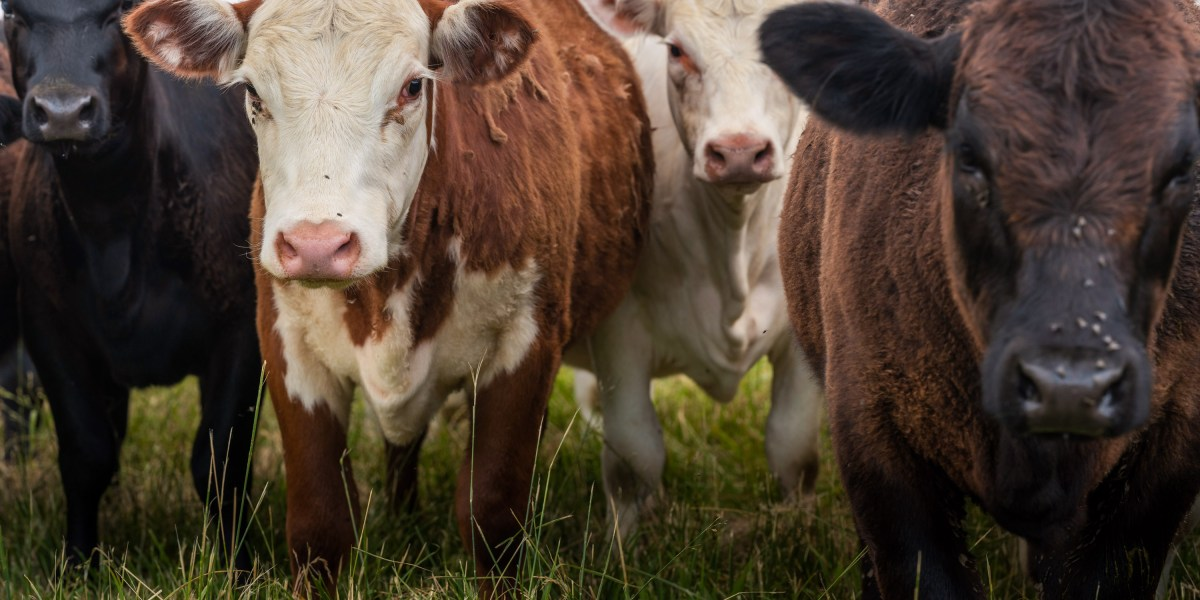
A new tick-borne disease is killing cattle in the US
November 2021
In the spring of 2021, Cynthia and John Grano, who own a cattle operation in Culpeper County, Virginia, started noticing some of their cows slowing down and acting “spacey.” They figured the animals were suffering from a common infectious disease that causes anemia in cattle. But their veterinarian had warned them that another disease carried by a parasite was spreading rapidly in the area.
After a third cow died, the Granos decided to test its blood. Sure enough, the test came back positive for the disease: theileria. And with no treatment available, the cows kept dying.
Livestock producers around the US are confronting this new and unfamiliar disease without much information, and researchers still don’t know how theileria will unfold, even as it quickly spreads west across the country. Read the full story.
—Britta Lokting
We can still have nice things
A place for comfort, fun and distraction to brighten up your day. (Got any ideas? Drop me a line or tweet ’em at me.)
+ This Instagram account documenting the weird and wonderful world of Beanie Babies is the perfect midweek pick-me-up.
+ Challengers is great—but have you seen the rest of the best sports films?
+ This human fruit machine is killing me.
+ Evan Narcisse is a giant in the video games world.